Bridging the Ethical Gap: Sustainability and Innovation in Coffee, July 2026
The 40% vs 4% Gap: Coffee's Ethical Purchasing Conundrum
For nearly two decades, the specialty coffee industry has wrestled with a sobering statistic. According to a United Nations estimate cited repeatedly in industry circles, 40% of consumers say they are willing to buy ethically produced goods. Yet only 4% actually follow through. That gap between intention and action has haunted sustainability efforts, from fair trade to direct trade to regenerative agriculture. The question has never been whether consumers care, but how to turn that care into consistent purchasing behaviour.
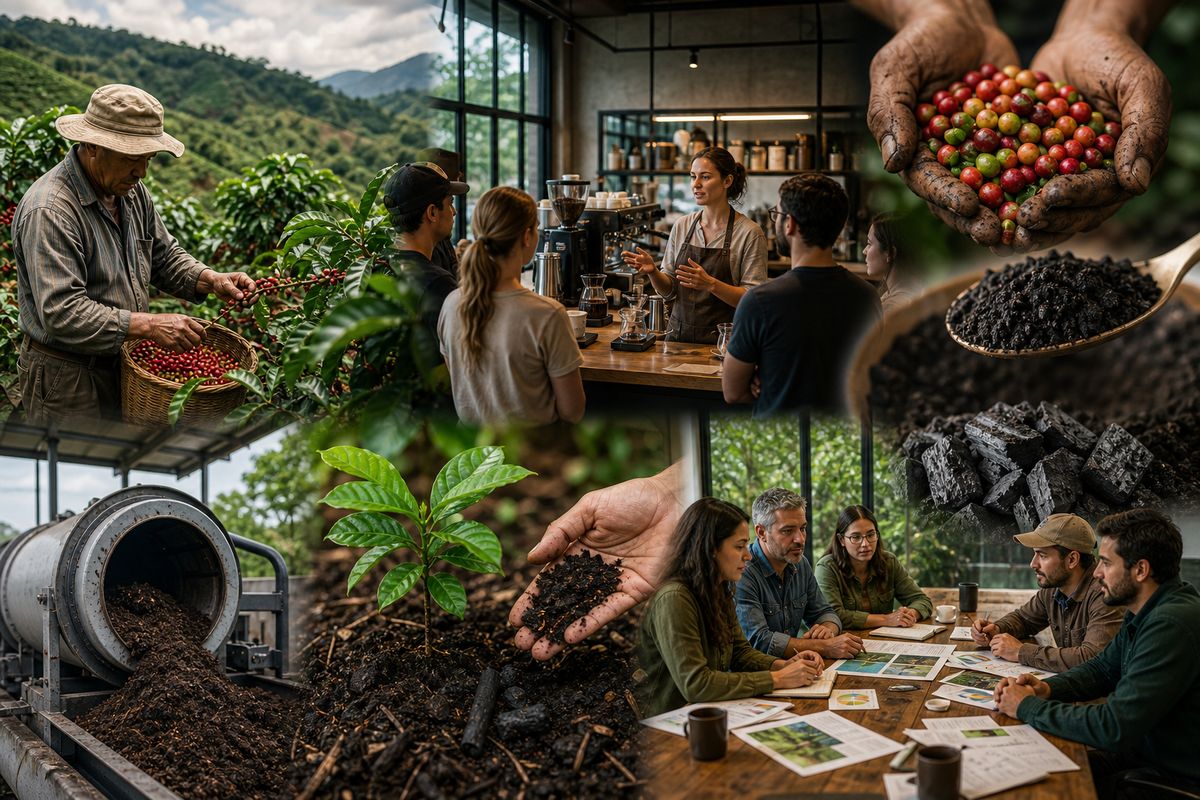
In the week ending 27 July 2026, the coffee world saw a flurry of developments that, together, point towards possible answers. A new showroom in Portland, Oregon, called Session Room is attempting to collapse the distance between coffee education and retail purchase. A study in the journal Biochar offers a novel use for spent coffee grounds that could reduce industrial pollution. And new analyses on regenerative farming and the European Union Deforestation Regulation (EUDR) underscore how complex the path to ethical coffee really is. The industry is not short on innovation. But bridging that 40% to 4% gap will require more than good intentions. It will require structural changes in how coffee is produced, processed, and marketed.
Session Room: Where Equipment, Training, and Fresh Coffee Converge in Portland
On 27 July 2026, Daily Coffee News reported the opening of Session Room, a new showroom and training space in Portland, Oregon. The venue brings together specialty coffee equipment demonstrations, in-person education, and fresh roasts under one roof. Located in two connected rooms, Session Room is designed to serve both coffee professionals and serious home enthusiasts. It allows visitors to test espresso machines, grinders, and brewers while also attending classes led by experienced trainers.
The concept is not entirely new. Coffee Equipment Pros opened a Texas showroom in June 2026, and roastery equipment sellers have long hosted training. But Session Room's integration of fresh roast sales with hands-on training creates a more holistic retail experience. For consumers who say they want ethical coffee, the ability to see, touch, and understand the equipment and the roast can build trust. It is one thing to read about direct trade; it is another to have a barista explain the supply chain while you taste a single-origin espresso pulled on a machine you might buy yourself.
Education as a Bridge to Ethical Purchasing
The showroom's focus on education directly addresses the intention-action gap. When consumers understand the craft and the cost behind specialty coffee, they are more likely to pay a premium. Session Room's model provides that context in a tangible way. It also supports local roasters by offering a dedicated space for fresh product sales, potentially boosting the visibility of small-batch roasters who struggle to break into retail. In a city like Portland, already saturated with coffee culture, Session Room differentiates itself by making the purchasing journey interactive rather than transactional.
Spent Coffee Grounds as Biochar: A New Frontier for Waste Valorisation
Also on 27 July 2026, a study published in the journal Biochar revealed another potential use for spent coffee grounds: converting them into biochar capable of treating toxic gases. The research adds to a growing list of industrial applications for coffee waste, which already includes filtering water, reducing plastic in wrap, improving cucumber growth, and strengthening concrete. The latest finding suggests that coffee-derived biochar can adsorb harmful gases, offering a low-cost, sustainable solution for air pollution control.
This development matters for the broader sustainability conversation. Coffee production generates enormous amounts of organic waste. Finding value in that waste reduces landfill burden and creates new revenue streams for producers. For roasters and cafes, participating in waste-to-biochar programmes could become a new selling point for ethically minded consumers. Instead of just talking about compostable cups, a cafe might advertise that its spent grounds are turned into biochar that cleans the air. That is a tangible, measurable environmental benefit that can close the gap between stated values and actual consumer behaviour.
From Waste to Resource: The Circular Economy in Coffee
The biochar study is part of a broader trend. In recent weeks, Daily Coffee News also covered research linking filter coffee to lower blood sugar via the gut microbiome, and the American Heart Association's statement that a certain number of cups per day is safe for most adults. These health and environmental stories reinforce coffee's potential as more than a commodity. They position it as a functional product with measurable benefits. For marketers, such evidence provides powerful narratives that can move consumers from passive sympathy to active purchase.
Regenerative Coffee and Living Incomes: A Nuanced Picture Emerges
On 23 July 2026, Daily Coffee News published an analysis titled "Can Regenerative Coffee Farming Deliver Living Incomes? It Depends." The piece, by Nick Brown, examines the claim that regenerative agricultural practices can simultaneously restore ecosystems and improve farmer livelihoods. The analysis finds that the answer is not straightforward. While regenerative methods can reduce input costs and build soil health, they often require significant upfront investment and may not yield immediate income gains.
The findings are critical for the ethical purchasing narrative. Many consumers are drawn to terms like "regenerative" because they imply a holistic solution to climate change and poverty. But if the farming practices do not reliably deliver living incomes, then the premium consumers pay may not reach producers effectively. The analysis underscores the need for institutional support beyond certification. In a separate column published on 21 July 2026, Bruno Benzaquen Perosa and co-authors argued that producers need institutional capacity for EUDR compliance, not just traceability technology.
The EUDR Challenge for Honduras and Beyond
The EUDR presents a massive challenge to the vital Honduras coffee sector, as Sandra Weiss reported on 22 July 2026. Honduras is a major coffee exporter, but its smallholder farmers often lack the documentation and infrastructure to prove their coffee is deforestation-free. Without that proof, they risk being locked out of the European market, which accounts for a large share of global specialty coffee sales. The regulation, while well-intentioned, could inadvertently harm the very producers it aims to protect.
This regulatory pressure amplifies the urgency of bridging the intention-action gap. Consumers in Europe may say they want deforestation-free coffee, but if the compliance burden crushes smallholders, the ethical outcome is negative. The coffee industry must invest in capacity building at origin, not just marketing at retail. Session Room's educational model and the biochar innovations are steps in the right direction, but they operate primarily in consuming countries. The real work is in the fields and cooperatives of producing nations.
Other Industry Developments: Health, Labelling, and Retail Innovation
The past week also brought several other notable stories. The FDA has eyed caffeine labelling as a 2026 priority, as reported by Nick Brown on 17 July 2026. With growing scrutiny on caffeine consumption, especially among young people, mandatory labelling could reshape how coffee companies market their products. It might also affect the ethical purchasing dynamic: consumers who want transparent information about what they consume will appreciate clearer caffeine content disclosures.
On the retail front, new cafes continue to open with a focus on producer partnerships. Dynamic Coffee in Pittsburgh and Camellia Coffee Roasters in Northern California both emphasize direct relationships with growers. Meanwhile, Field Study Coffee in Brooklyn introduced a reservation-only service model, a sign that the cafe experience is evolving. And from Taiwan, the Orbiter OB-1 Pro roaster has entered the small roaster sphere, offering new technology for micro-roasters who want to scale up without losing quality control.
Health Studies and Consumer Confidence
A study linking filter coffee to lower blood sugar via the gut, published 21 July 2026, adds to the evidence that coffee consumption can be part of a healthy lifestyle. The American Heart Association also issued guidance on safe consumption levels for most adults. These findings help counteract negative perceptions about caffeine and can support premium pricing for high-quality, health-conscious products. When combined with ethical claims, such health benefits create a powerful value proposition.
Closing the Gap: What the Coffee Industry Must Do Next
The developments of late July 2026 paint a picture of an industry in flux. Innovation is abundant, from waste-to-biochar research to immersive retail spaces. Yet the persistent 40% vs 4% gap shows that innovation alone is not enough. Consumers need consistent, credible signals that their ethical purchases make a real difference. That requires transparency throughout the supply chain, from farm to cup.
Session Room's approach of combining equipment, education, and fresh roast is promising because it builds consumer knowledge and trust. The biochar research offers a tangible environmental benefit that can be communicated simply. But the most critical factor remains the livelihoods of producers. Regenerative farming, EUDR compliance, and living incomes are interconnected challenges that demand coordinated investment.
For coffee businesses, the path forward is clear: invest in education at every touchpoint, support producer capacity building, and communicate impact with honesty and precision. The ethical consumer is out there, waiting for a reason to move from intention to action. The coffee industry has the tools. Now it needs the will to use them consistently.