Cold brew coffee goes mainstream in 2026, and home brewing gets smarter
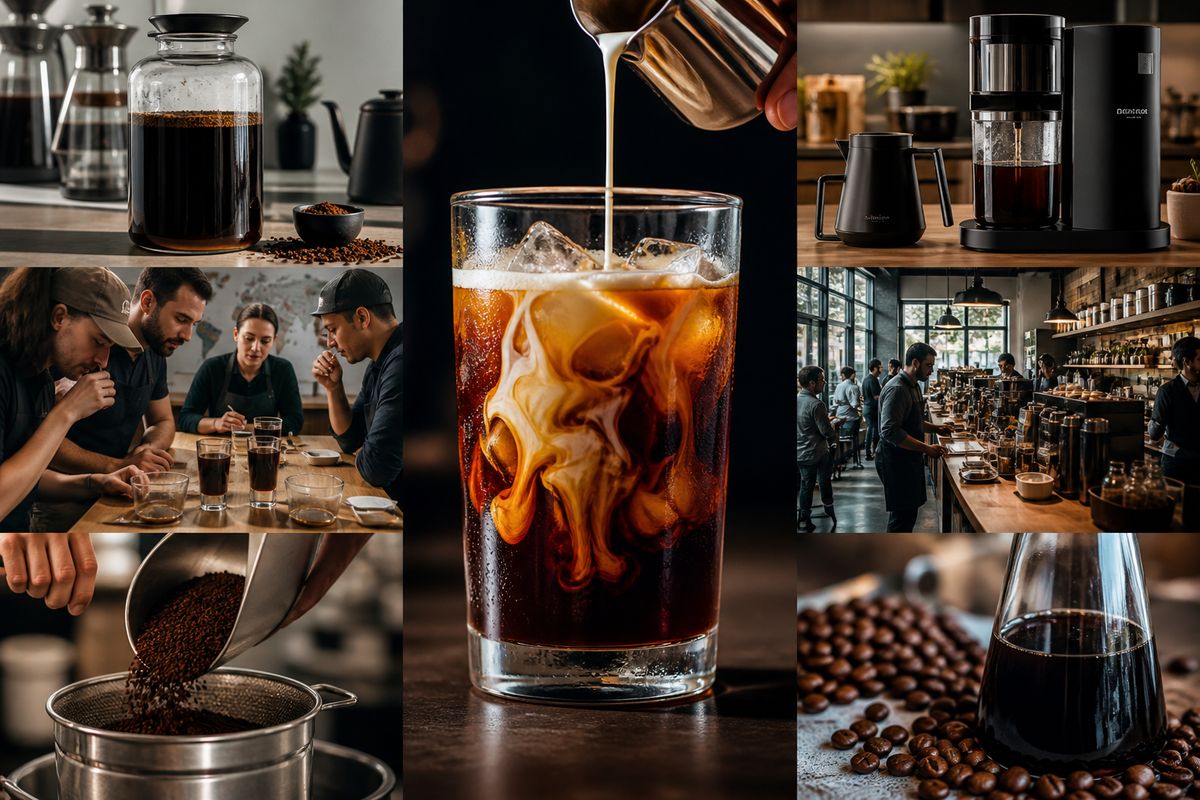
Cold brew coffee in 2026, the “simple” drink that keeps evolving
Cold brew coffee is not new, but the way people make it at home is changing fast in 2026. The latest wave of brew guides and product-led tutorials from brands and retailers points to the same story: cold brew is now treated as a repeatable, measurable process, not a vague overnight soak. And that shift matters, because it pulls cold brew out of the café-only category and into everyday kitchens, offices, and hospitality operations.
Three pieces of source material illustrate the trend from different angles. Devoción publishes a tightly specified cold brew brew guide with clear ratios, steep time, and storage advice, plus a commercial nudge towards beans selected for cold brewing (Devoción cold brew guide). Seattle Coffee Gear frames cold brew as “one of the simplest ways to make coffee”, then ranks five at-home methods by taste, effort, and time, including a machine-assisted “flash cold brew” mode on the Fellow Aiden (Seattle Coffee Gear cold brew methods). And Lavazza leans into the science and history, arguing that cold extraction changes chemistry, acidity, and shelf life, while also tracing early cold coffee evidence to Kyoto in the 16th century (Lavazza cold brew explainer).
Put together, the “news” is not a single corporate announcement. It is the industry’s direction of travel. Cold brew is being standardised, productised, and accelerated, all at once. The result is a category that looks more like a system than a recipe. Fair enough, because consumers now expect consistency, and they expect it at home.
The 2026 development, cold brew coffee becomes a repeatable home process
The most concrete signal is how prescriptive the leading guides have become. Devoción’s recipe is built around two explicit approaches: a ready-to-drink method at a 1:10 coffee-to-water ratio, and a concentrate method at 1:5. The guide even provides an example measurement, 25g of coffee per 250ml of water for ready-to-drink, or 25g per 125ml for concentrate. It specifies cold or room temperature filtered water, a coarse grind, and a 14-hour brew time. And it adds a “coffee rest period” of 10 to 14 days off the roast date, a detail that quietly signals a more specialty-minded approach to cold brew than many supermarket recipes.
Seattle Coffee Gear, meanwhile, treats cold brew as a set of methods that can be compared and scored. It distinguishes concentrate versus ready-to-drink outputs, and it draws a bright line between cold brew and iced coffee: iced coffee is hot coffee brewed over ice, while cold brew is steeped in cold or room temperature water, usually overnight. That distinction is not just coffee pedantry. It is a consumer education push, and it is happening because the market is crowded with “cold coffee” products that taste very different.
Then there is the acceleration story. Seattle Coffee Gear highlights “flash cold brewing” on newer brewers such as the Fellow Aiden. The description is careful: it is an approximation that brews at lower temperatures than standard drip and uses a longer brew time, producing a ready-to-drink cold brew-style cup more quickly, though it may come out warm and need ice. The point is not that overnight steeping disappears. It is that the category now includes speed-focused alternatives that aim to deliver the cold brew flavour profile without the 12 to 24 hour wait.
Finally, storage and shelf life are being treated as part of the method, not an afterthought. Devoción says refrigerated concentrate in an air-tight container lasts 7 days, and once diluted it lasts 3 to 4 days. Lavazza, by contrast, says concentrate stored in an airtight glass container in the fridge stays fresh for up to two weeks, specifically 10 to 14 days, while diluted or mixed batches should be consumed within 2 to 3 days. The numbers differ, and that is worth noting rather than smoothing over. But the shared message is clear: cold brew is now a batch beverage with food-safety expectations, and brands are actively shaping how long consumers keep it.
Background, the people, brands, and techniques shaping cold brew coffee
Devoción positions itself as a brand that cares about process control. Its guide reads like a checklist: container with lid or French press, strainer, scale, filtered water. It also pushes best practice in a way that will feel familiar to anyone who has spent time around specialty coffee. Use a burr grinder for even particle size. Weigh coffee rather than scooping because bean density varies. Adjust grind size to manipulate brew time, coarser decreases brew time and finer increases it. None of that is exactly groundbreaking, but it is significant that cold brew, once marketed as “forgiving”, is now being taught with the same discipline as pour-over.
Seattle Coffee Gear plays a different role in the ecosystem. As a retailer and educator, it frames cold brew as accessible, then offers a menu of approaches. It describes flavour-infused cold brew concentrates, including an orange spice version using an orange ring, cinnamon sticks, and star anise. It also suggests a low-mess “tea-bag steep” using a tea bag or mesh filter, with a practical warning: do not pack the grounds because they need room to move for proper extraction. And it includes classic press-based brewing, French press, AeroPress, and OXO Rapid Brewer, which matters because it normalises cold brew as something existing equipment can do.
Lavazza brings brand authority and a broader narrative. It emphasises chemistry, oxidation, and extraction speed, arguing that cold water extracts more slowly and leaves bitter compounds behind, producing a low-acidity coffee that highlights sweeter, chocolatey notes. It also provides a historical hook: evidence of cold coffee in Kyoto, Japan, as early as the 16th century, with Dutch merchants potentially brewing with cold water on ships to avoid fire hazards. That history is not just trivia. It is a reminder that “cold brew” is a modern label for a much older idea, and that today’s category is a remix of global practices.
Across all three sources, a few technical themes repeat. Coarse grind is non-negotiable. Water quality matters because coffee is “98% water”, a line used by both Devoción and Lavazza. And filtration is a quality lever: Lavazza recommends a double-filtration method, first through a metal mesh sieve or French press, then through a paper filter, to reduce fines and produce a clearer cup. In other words, cold brew is being treated less like a rustic infusion and more like a controlled extraction pipeline.
How to make cold brew coffee in 2026, what the best guides agree on
Despite differences in tone and brand goals, the practical overlap is striking. Devoción’s core method is straightforward: add coarse grounds to a vessel, add the appropriate amount of cold or room temperature water, stir to saturate, cover and steep for 14 hours, then strain promptly to avoid bitterness. For concentrate, it advises diluting with equal parts water, or to taste. Seattle Coffee Gear echoes the essentials: a vessel, coarsely ground coffee, a filter or straining method, and a refrigerator that is optional for brewing. Lavazza reinforces that coarse grind prevents over-extraction during long contact times, and it warns that fine espresso grind will push the brew into bitterness.
Ratios are where cold brew starts to look like a repeatable system rather than a vibe. Devoción gives two clear ratios: 1:10 for ready-to-drink and 1:5 for concentrate, with example weights and volumes. Lavazza does not publish a single ratio in the provided excerpt, but it strongly argues for precise measurement to remove guesswork and produce a balanced cup. Seattle Coffee Gear focuses more on method comparison than a single canonical recipe, but it repeatedly returns to the idea that some methods yield concentrate that should be diluted, while others aim for ready-to-drink.
Water and storage are the other big levers. Devoción recommends filtered water and says cold brew concentrate lasts 7 days refrigerated in an air-tight container, while diluted cold brew lasts 3 to 4 days. Lavazza is more specific about materials: airtight glass is preferred because plastic can absorb fridge odours, and oxygen is the enemy. It states concentrate can last up to two weeks, 10 to 14 days, but diluted or mixed batches should be consumed within 2 to 3 days. The takeaway for readers is not to pick a “winner” between 7 days and 14 days. It is to recognise that shelf life depends on handling, dilution, and contamination risk, and that brands are increasingly explicit about it.
And then there is the speed question. Traditional steeping is still the baseline, often overnight. But flash cold brew modes, like the Fellow Aiden option described by Seattle Coffee Gear, represent a growing subcategory: cold brew flavour, faster turnaround, and more appliance-led consistency. It is the same pattern seen in other food and drink categories, where convenience tech does not replace the craft method, it simply expands the market.
Industry analysis, what this means for coffee retail, equipment, and cafés
The cold brew market’s centre of gravity is shifting from cafés to households, and the sources show how. When a brand like Devoción publishes a detailed brew guide and pairs it with “cold brew favourites” and bundles, it is not just education. It is a conversion funnel. The guide recommends a scale, a burr grinder, and specific coffees, and it frames cold brew as something worth dialling in. That is a direct challenge to the idea that cold brew is only a summer café treat. It becomes a weekly batch routine, which in turn supports repeat bean purchases.
Retailers benefit too, because method diversity sells gear. Seattle Coffee Gear’s five-method framing is essentially a map of product categories: jars and filters, French presses, AeroPress-style devices, rapid brewers, and machine-assisted solutions like the Fellow Aiden. The more “valid” methods there are, the more entry points consumers have. Some will choose the mason jar route because it is low effort. Others will buy a dedicated brewer because they want speed and consistency. And once a consumer buys equipment, they tend to stick with the habit. That is the quiet commercial logic behind all this content.
For cafés, the implications are mixed. On one hand, better home cold brew could reduce impulse purchases of bottled cold brew and iced drinks. On the other, it raises consumer expectations, and that can push cafés to differentiate with origin-specific cold brew, nitro service, or flavour-forward seasonal recipes that are harder to replicate at home. Lavazza’s emphasis on low acidity and chocolatey notes hints at another café opportunity: positioning cold brew as a stomach-friendly option, especially for customers who find hot coffee too sharp. The sources do not provide market statistics on this, so it would be wrong to claim a quantified shift. But the strategic direction is plain: cold brew is no longer a niche, it is a baseline offering that must be executed well.
Equipment makers are also nudged towards “cold brew modes” and hybrid extraction programmes. Flash cold brew is a telling phrase. It borrows the language of speed and modernity, but it still anchors itself in taste similarity to cold brew. That is a product design brief in one sentence: deliver the cold brew profile with less waiting, and do it reliably. Expect more machines to compete on that axis, because time is the one variable consumers complain about most.
Why It Matters
Cold brew coffee’s real 2026 story is not that people like it. They clearly do. The story is that cold brew is becoming a literacy test for the wider coffee category. When guides insist on filtered water because coffee is 98% water, or when they argue about counter versus fridge steeping, they are teaching consumers to think in variables: ratio, grind, time, filtration, storage. That mindset spills over. Someone who starts weighing coffee for cold brew is far more likely to start weighing coffee for pour-over, or to care about grinder quality, or to notice when a café’s iced coffee is just hot coffee dumped on ice (and tastes like it).
There is also a subtle but important reframing of “quality”. Cold brew used to be sold as forgiving, almost foolproof. Now, the same content ecosystem pushes precision and repeatability. Devoción talks about bean density and why scoops are unreliable. Lavazza recommends double filtration to avoid a silty cup. Seattle Coffee Gear scores methods on taste, effort, and time, implicitly telling readers that trade-offs are real and measurable. This is consumer education, yes. But it is also category maturation. Once a category matures, brands compete on process, not just flavour adjectives.
And finally, cold brew is becoming a platform for innovation in a way hot coffee rarely is. Flavour infusion, concentrate dilution strategies, and machine-assisted “flash” modes all sit comfortably under the cold brew umbrella. That flexibility is a big deal for product developers and hospitality operators because it supports menu experimentation without retraining customers from scratch. The label “cold brew” does a lot of work. It signals smoothness, lower perceived acidity, and refreshment. Then brands can riff on it, and consumers tend to follow along.
Historical context, from Kyoto drip to today’s concentrate culture
Lavazza’s historical note about Kyoto in the 16th century is a useful corrective to the idea that cold brew is a modern invention. The Kyoto style is traditionally brewed drop by drop rather than by full immersion, creating a slow, theatrical extraction. The source also suggests Dutch merchants may have brewed cold coffee on ships to avoid fire hazards during long crossings, which is a practical origin story that fits the method’s strengths. Cold water is safer than flame at sea. Sometimes innovation is just common sense.
That history also helps explain why cold brew keeps resurfacing in different forms. It is adaptable. In some cultures it becomes a slow-drip ritual; in others it becomes a strong concentrate designed to be diluted, sweetened, or mixed with milk. The modern US and European trend towards bottled concentrates and ready-to-drink cans is not directly covered in the provided sources, so it is not appropriate to claim specific market trajectories. But the logic is consistent with what the guides emphasise: shelf life, batch brewing, and dilution control are tailor-made for packaged formats.
Comparisons with iced coffee are central to today’s consumer understanding. Seattle Coffee Gear states it plainly: iced coffee is hot coffee brewed over ice, while cold brew is steeped in cold or room temperature water, usually overnight. Lavazza adds the chemistry argument: hot water extracts oils and acidic notes rapidly, while cold extraction is slower and leaves more bitter compounds behind, producing a smoother, low-acidity result. This distinction is now part of mainstream coffee language, and it shapes purchasing decisions. People are not just ordering “cold coffee”. They are ordering a method.
In that sense, 2026 feels like a consolidation year. The method is old, but the messaging is new: cold brew is precise, it is scalable, and it is increasingly supported by purpose-built equipment. The category is settling into its mature form, with room for both the mason jar crowd and the gadget enthusiasts.
Closing thoughts, where cold brew coffee goes next
The cold brew coffee playbook in 2026 is clear. Standardise the basics, ratio, coarse grind, filtered water, and sensible steep times. Teach consumers to store it properly and to treat concentrate differently from diluted drinks. Then offer choices: flavour infusions for creativity, double filtration for clarity, and flash cold brew modes for speed. The sources do not claim a single “best” approach, and that is the point. Cold brew is now a family of methods with a shared flavour promise.
For consumers, the immediate win is consistency. Devoción’s 1:10 and 1:5 ratios remove guesswork. Lavazza’s storage guidance, airtight glass, oxygen avoidance, and a clear distinction between concentrate shelf life and diluted shelf life, reduces waste and disappointment. Seattle Coffee Gear’s method comparisons help people choose a workflow that fits their life, whether that is a low-effort jar steep or a machine-led shortcut.
For the industry, the bigger picture is that cold brew has become a gateway into higher engagement coffee. Once people start caring about grind size and water quality for a cold drink, they tend to care about it everywhere else too. And that, for coffee brands and equipment makers, is the real prize. Not just one more beverage. A more educated, more confident customer base that keeps coming back.