Coffee Industry in Flux: Espresso Math, EU Billions and Tariff Headwinds
The Science and Economics of Coffee in July 2026
The coffee world rarely stands still, but the first full week of July 2026 has delivered an unusually dense bundle of news. From a new mathematical model that promises to take the guesswork out of espresso extraction, to a blockbuster report quantifying coffee's €84.4 billion contribution to the European Union economy, to a fresh tariff threat that could upend supply chains between Brazil and the United States. Add in a flagship espresso machine from La San Marco and smallholder farmers in Brazil struggling with a shifting climate, and you have a snapshot of an industry under simultaneous pressures: scientific, economic, environmental and political.
This is not a slow news month. It is a moment where every link in the coffee chain, from the farmer to the financial trader, is being forced to adapt. Let us walk through the key developments and what they mean for the months ahead.
Mathematics Meets Espresso: A New Model for Dialling In
On 8 July 2026, Daily Coffee News reported that researchers have published a mathematical model for predicting how water flows through a coffee puck during espresso extraction. The model, which builds on decades of fluid dynamics research, offers a framework that could eventually help baristas and roasters remove much of the trial-and-error from dialling in a shot.
The science behind espresso is notoriously complex. Variables such as grind size, dose, tamp pressure, water temperature and pressure profile all interact in ways that are difficult to predict. The new model, developed by a team whose details were not fully elaborated in the source material, appears to simulate the porous structure of the coffee bed and the channeling effects that can ruin extraction. If validated in practice, this could be a major leap for specialty coffee, where consistency is everything.
Of course, mathematical models are not new to coffee. Companies like Breville and Decent Espresso already use algorithms to control pressure profiles. What sets this approach apart is its focus on the physical properties of the coffee puck itself, rather than just machine parameters. It is one thing to control the machine; it is another to predict how a specific coffee will behave before you even pull the shot.
The Practical Impact for Baristas
For working baristas, this could mean less waste, faster training and more consistent quality. For roasters, it could inform how they develop profiles for espresso blends. But the research is still at the model stage; real-world testing in cafes will be needed before it becomes a tool rather than a theory. Still, it signals a direction: the relentless digitisation and quantification of craft.
Coffee's €84.4 Billion Mark in the European Union
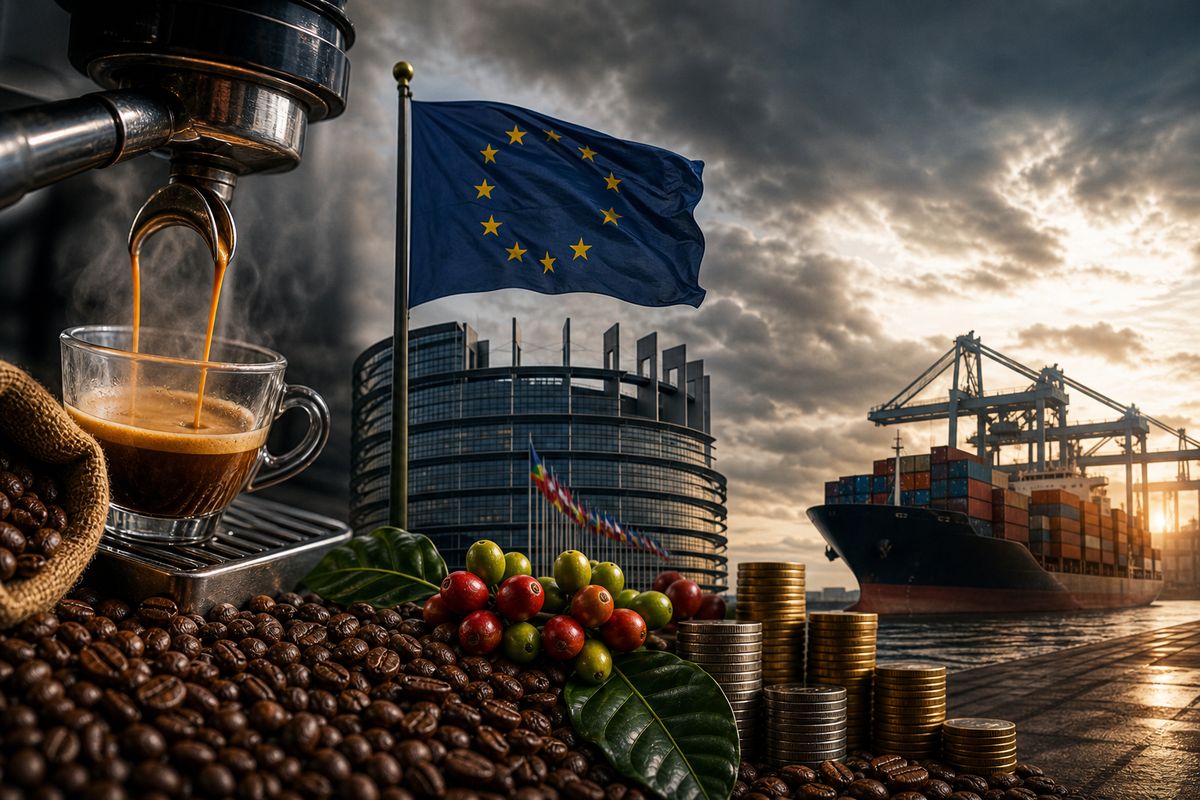
On the same day, another piece of news underlined just how big the coffee industry really is. A new report commissioned by the European Coffee Federation (as referenced in the source) found that coffee generates €84.4 billion in gross added value across the 27 member states of the European Union. It directly supports approximately 1.5 million full-time-equivalent jobs.
That figure covers everything from growing (though most EU coffee is imported) to roasting, retail and cafe employment. It does not include indirect effects like tourism or equipment manufacturing. To put it in perspective, €84.4 billion is more than the GDP of some small EU nations. Coffee is not just a morning ritual; it is a major economic engine.
The report, published on 8 July 2026, comes at a time when the EU is tightening regulations on deforestation, packaging waste and chemical use, all of which affect how coffee is sourced and sold. The industry's economic weight gives it leverage in Brussels, but also invites scrutiny. Expect the report to be cited heavily in lobbying around the upcoming EU Deforestation Regulation enforcement dates.
La San Marco Debuts the La 125: Heritage Meets Modern Engineering
Also on 8 July, Italian espresso machine manufacturer La San Marco, now owned by French conglomerate Groupe SEB, unveiled its new flagship machine: the La 125. The machine represents a blend of the company's 100-plus-year heritage and Groupe SEB's industrial scale.
Details from the Daily Coffee News report indicate that the La 125 is designed for high-volume specialty cafes and likely incorporates advanced temperature stability and pressure profiling. La San Marco has traditionally been a workhorse brand in Italian cafes; with Groupe SEB's backing, it is aiming for a more global, premium positioning. The move pits it directly against competitors like La Marzocco, Slayer and Synesso.
The launch is significant because it shows that even in an era of automation and smart machines, there is still a market for beautifully engineered, manually operated espresso machines. Coffee professionals remain willing to invest in hardware that gives them control, even as algorithmic tools like the one described earlier promise to simplify the process.
Brazil's Changing Coffee Climate: Small Farmers Adapt or Perish
Beneath the big financial and technological headlines, a quieter crisis is unfolding in Brazil, the world's largest coffee producer. A column published on 7 July 2026 by Kevin Damasiano, originally on Dialogue Earth, profiles Edson Paes, 53, who has single-handedly cultivated 12,000 organic Arabica coffee plants in the face of a shifting climate.
Brazil's coffee regions are experiencing higher average temperatures, more erratic rainfall and an increased prevalence of pests like the coffee borer beetle. For small farmers who lack the capital to irrigate or move to higher altitudes, the margins are razor thin. Paes' story is one of adaptation: he has diversified into shade-grown coffee, intercropping, and organic certification to fetch premium prices. But not all farmers can make that leap.
The broader picture, as reported by Daily Coffee News on 26 June 2026, is that borer infestations are expanding across Brazilian growing regions. This is a direct consequence of warmer winters that no longer kill off the pest's larvae. Without concerted support for smallholders, Brazil's coffee output could become more volatile and more concentrated in the hands of large, mechanised farms.
The Threat of US Tariffs on Brazilian Coffee
Add to that a proposed 25% US tariff on Brazilian instant coffee, as reported by Traders Union on 8 July 2026. The tariff, if enacted, would disrupt import-dependent supply chains and likely raise costs for American consumers and businesses. Instant coffee may seem like a niche segment, but it represents a significant volume of Brazilian exports to the US.
The same report notes that coffee futures (KC) are trading at around $316.88 per pound (though the source also mentions a price of $309.91 at different times), with technical indicators showing a bearish bias. The asset remains below its 20-day moving average but above longer-term averages, a sign of short-term weakness within a broader uptrend.
Market analyst Viktoras Karapetjanc of Traders Union is quoted as saying: "Ongoing tariff negotiations and technical signals create opportunity, but prudent risk management is essential in the current setup."
This tariff threat adds a layer of geopolitical uncertainty to an already nervous market. Brazil is not the only origin facing disruption; Vietnam's robusta boom is also under scrutiny, as a 1 July report noted that the boom faces a "reckoning" due to oversupply and environmental degradation.
Why It Matters: The Coffee Industry at a Crossroads
Pulling these threads together reveals a coffee industry that is simultaneously advancing and under threat. The mathematical model for espresso and the La San Marco La 125 represent progress: better extraction, better machines, better coffee. The EU economic report shows the industry's immense value. But the climate story from Brazil and the tariff threat remind us that coffee is a fragile system.
The real insight here is the tension between efficiency and resilience. The mathematical model aims to make extraction more efficient, reducing waste and improving consistency. The tariff and climate pressures, however, underscore that efficiency at the source is not keeping pace. You can have the perfect shot of espresso in a London cafe, but if the farmer who grew those beans cannot survive the next drought or trade war, the supply chain breaks.
What is missing from the mainstream coverage is an honest reckoning with the cost of adaptation. The EU report's €84.4 billion figure is impressive, but how much of that is being reinvested into origin communities? The new machines and models are exciting, but they serve a market that still largely externalises the risks of climate change and trade volatility. Until the industry uses its economic weight to fund adaptation on the ground, stories like Edson Paes will remain exceptions rather than the rule.
The next twelve months will be telling. If the US tariff on Brazilian coffee goes through, it could trigger a price spike that hurts roasters and consumers but does little to help the farmer. If the mathematical model is commercialised, it could shift power from the barista's intuition to the algorithm. Either way, the coffee industry is not just brewing a drink; it is brewing a future that will require difficult choices.
Closing Thoughts: A Week That Captures a Decade of Change
July 2026 may be remembered as a moment when the coffee industry's trajectory became clearer. The technological leaps are real. The economic impact is staggering. But the vulnerabilities are equally stark. For anyone who drinks coffee, these stories matter because they determine what will be available, at what price, and at what human and environmental cost.
Keep an eye on the tariff negotiations in Washington, the rains in Brazil, and the patent filings from those espresso modellers. The coffee of 2030 will look different, and it is being shaped right now.