RDT spray bottle for coffee beans: why baristas mist water before grinding
RDT spray bottle for coffee beans moves from niche hack to everyday kit
The humble RDT spray bottle for coffee beans is having a moment, and it is not just another coffee gadget chasing Instagram likes. A growing number of home baristas and equipment retailers now treat RDT, short for the Ross Droplet Technique, as a normal part of espresso prep, right alongside WDT and single dosing. The latest signal is commercial, not theoretical: Central Coast Coffee in Australia is actively selling an RDT spray bottle as a dedicated anti static tool, priced at $9.95 AUD, with 200+ in stock and positioned as part of a “more civilised way to prep espresso”.
That matters because it shows where the market is heading. RDT used to be something enthusiasts debated on forums. Now it is packaged, demonstrated in showrooms, and marketed as a workflow upgrade that reduces mess, lowers retention, and improves shot consistency. And, crucially, there is science behind it. A study published in Matter in late 2023, led by Dr. Christopher Hendon at the University of Oregon, reports that adding a small amount of water before grinding can eliminate static and improve extraction yield by up to 10%, according to a summary by 43 Factory Coffee.
So what is the actual news event here? It is the mainstreaming of RDT as a product category and a standardised practice, not merely a tip. Retailers are bundling it into “standard routines”, and educational content is increasingly explicit about how and why it works, plus where it can go wrong. In 2026, that combination, product availability, community adoption, and published research, is pushing RDT from a clever trick into a repeatable, teachable method.
What is happening now: RDT spray bottles are being sold and taught as standard espresso workflow
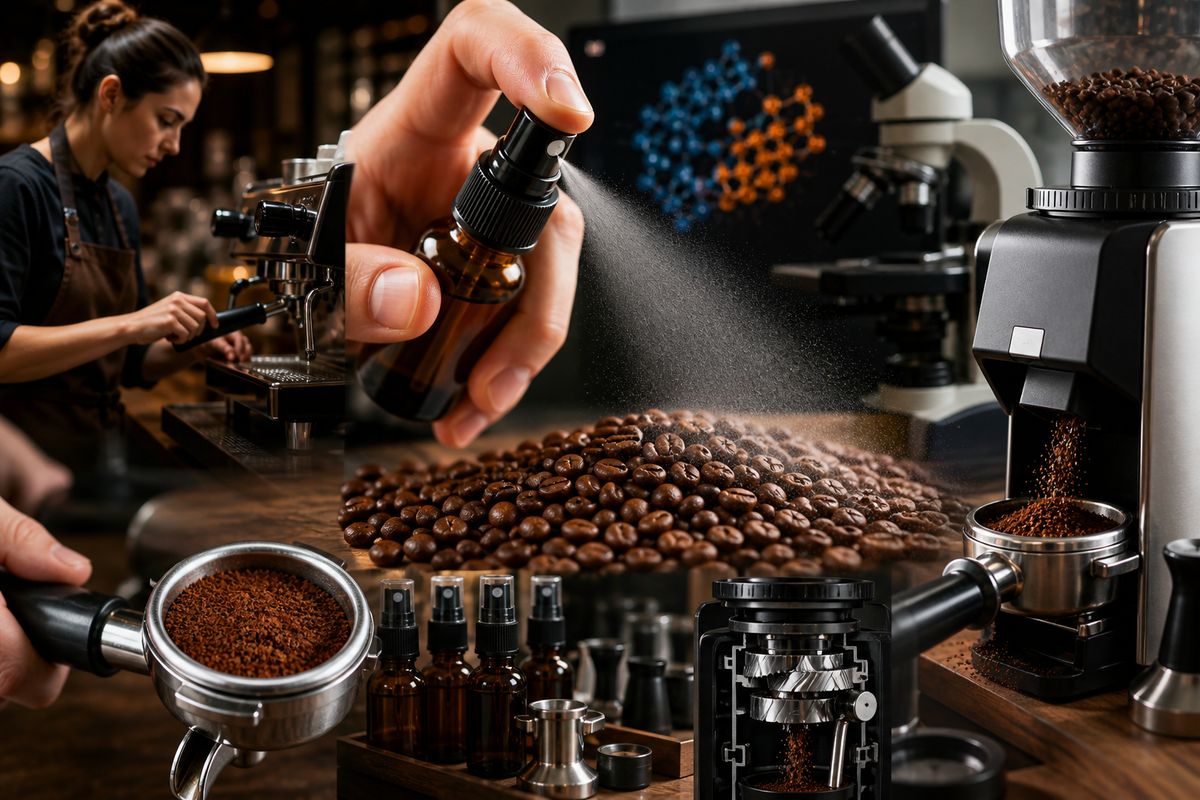
Central Coast Coffee’s listing frames RDT as a small, practical intervention: “a tiny mist of water applied to your coffee beans before grinding to reduce static and retention”. The product itself is straightforward, a 30 ml amber bottle with a fine mist spray, described as portable and refillable, with a claim that 30 ml should get a week or more of use depending on frequency. It is categorised under grinder accessories and explicitly tied to single dose espresso routines, including a mention of using a dosing tray to mist evenly before grinding and then following with WDT for puck prep.
There is also a subtle but important commercial cue: the product is presented as part of a broader ecosystem of modern espresso habits, not a standalone novelty. The listing references “single dosing”, “WDT”, and even name checks Weber, via a customer review that calls it “well made” with a “glass body and efficient spray unit”. In other words, the retailer is speaking the language of the enthusiast market, then making it accessible and purchasable in a couple of clicks. The page also offers in store demonstrations by appointment at its Somersby, NSW showroom, which is another sign that these techniques are becoming teachable retail experiences, not just online lore.
Alongside retail, education is sharpening. 43 Factory Coffee lays out a clear, repeatable method: weigh a dose, spray 1 to 2 fine mists from 5 to 10 cm above the beans, shake to distribute, then grind immediately. It also adds the guardrails that often get skipped in social media clips: do not spray into a full hopper, do not store damp beans, and do not overdo the water because it can create sludge and potentially lead to corrosion on burrs that are not corrosion resistant.
Put together, the “event” is less a single announcement and more a visible shift in the espresso equipment market in 2026: RDT is being productised, operationalised, and normalised. That is how niche practices become industry defaults, one workflow at a time.
Background: the Ross Droplet Technique, from a 2005 forum post to published research
RDT stands for the Ross Droplet Technique, named after David Ross, who first shared it on the Home Barista forum in 2005, according to 43 Factory Coffee. The original idea is almost comically simple: add an extremely small amount of water to pre weighed beans just before grinding. Not a soak, not a rinse, just a droplet or a fine mist. The goal is to reduce static electricity that builds up when dry roasted beans are ground at speed.
Why does static matter? Because it is not just a cleanliness issue, although anyone who has wiped coffee dust off a counter at 7am will appreciate that angle. Static contributes to clumping, scattering, and grounds sticking to chutes and catch cups. That affects dose accuracy, retention, and the uniformity of the coffee bed. In espresso, where small changes in puck density and distribution can swing shot time and flavour, those little annoyances add up.
The 43 Factory Coffee explanation is unusually clear on the physics. Roasted coffee beans contain very low moisture. When fractured by metal burrs, friction generates electrical charge. Particles with the same charge repel, which helps explain why fines can fly around and cling to surfaces. Add a microscopic layer of water, and the conductive properties of water help dissipate charge into the grounded metal body of the grinder, rather than letting it accumulate on the coffee particles. It is not magic. It is basic electrostatics applied to a very specific, very messy problem.
Then comes the modern twist: evidence. 43 Factory Coffee cites a late 2023 study in Matter, led by Dr. Christopher Hendon, reporting that a small amount of water before grinding can eliminate static, densify the coffee bed, reduce clumping, improve water distribution, and increase extraction yield by up to 10%. The source material does not provide the full methodology or sample sizes, so it is not possible to interrogate the details here. But the headline finding is still significant because it gives RDT something the coffee world often lacks, a bridge between anecdote and measurement.
Why baristas spray water on coffee beans: the practical benefits and the real risks
In practice, RDT is about control. Static makes the grinder behave unpredictably. Grounds cling to the chute, retention rises, and the dose you thought you had can end up split between the cup and the grinder’s internals. A quick mist changes that behaviour. Central Coast Coffee claims it “reduces grinder static and mess”, “minimises retention inside the grinder”, and helps create “fluffier, more even grounds”, which in turn makes WDT easier and more effective. That is a neat chain of cause and effect: better flow through the grinder, better prep at the basket, better repeatability in the cup.
43 Factory Coffee adds a workflow level view: RDT is particularly aligned with single dose grinding, where the barista weighs a dose, treats it, then grinds immediately. The steps are quick, weigh beans, spray 1 to 2 mists, shake, grind. The article claims it adds “about 3 seconds” to the workflow. That is believable, and it is exactly why the technique spreads. It is low effort, low cost, and the payoff is visible immediately, less mess, less clumping, less frustration.
But there is a catch, and it is a big deal if people get sloppy. Water and metal burrs are not natural friends. 43 Factory Coffee is blunt about the boundaries: never spray into a full hopper, because storing moist beans in a closed hopper can create an environment for mould growth. And do not overuse water. The principle is “less is more”, with the source stating that 1 to 2 sprays, “less than 0.1 g of water”, is sufficient. Too much water can mix with fines to form sticky sludge, clogging burr teeth and blocking the discharge chute. Prolonged exposure to moisture can also cause rust on burrs that are not corrosion resistant.
So the technique is simple, but it is not casual. The industry implication is that as RDT becomes mainstream, retailers and educators will need to keep emphasising safe usage. Otherwise, the same practice that improves consistency could become a driver of warranty claims and grinder maintenance headaches. Fair enough, nobody wants that.
RDT spray bottle for coffee beans meets slow feeding: how modern espresso workflows are converging
RDT is not happening in isolation. It is part of a broader shift towards micro optimisations in home espresso, where enthusiasts stack small improvements to chase repeatability. Grind Logic’s discussion of slow feeding is a good example. Slow feeding means starting the grinder first and feeding beans gradually over a few seconds, rather than dumping the full dose in at once. The rationale is that a controlled feed can reduce burr load and, in some grinders, slightly reduce fines and tighten particle distribution.
Grind Logic is careful not to oversell it. Slow feeding can sometimes improve consistency, especially for espresso, but it is “not a substitute for fresh coffee, good dial in, and a consistent workflow”. That framing is important because it mirrors the reality of RDT too. Neither technique fixes stale beans or poor puck prep. They are refinements. Useful ones, sometimes surprisingly so, but still refinements.
The interesting overlap is how these practices complement each other. RDT addresses static and retention, which are partly about how particles behave after grinding. Slow feeding addresses how beans enter the burrs and how the grind distribution forms in the first place. Put them together and, in the right setup, the barista is controlling both ends of the process: the feed rate into the burrs and the electrostatic behaviour of the grounds coming out. That is why these techniques are often discussed in the same breath in enthusiast circles, and why retailers increasingly sell tools that support both, dosing cups, trays, sprayers, and single dose grinders designed for low retention.
Grind Logic also notes that some grinders already mitigate static through design, citing the DF54 and DF64 Gen 2 as having an ioniser for static management. That is a reminder that RDT is not always mandatory. In some setups, it may be redundant. But the fact that people still reach for RDT even when grinders include anti static features suggests something else is going on: users want a belt and braces approach, and they want consistency across different coffees, roast levels, and humidity conditions.
Industry implications: accessory sales, grinder design, and the new baseline for “clean” grinding
On the commercial side, the rise of the RDT spray bottle is a classic example of a micro accessory becoming a meaningful category. At $9.95 AUD, Central Coast Coffee’s product is inexpensive enough to be an impulse add on, but specific enough to feel like a “serious” tool rather than a generic cosmetic atomiser. That positioning is clever. It lowers the barrier to entry for better workflow, and it creates a small but steady revenue stream for retailers that already sell grinders, beans, and other accessories.
There is also a brand and education angle. Central Coast Coffee highlights fast dispatch from Somersby, NSW, local pickup, and in store demonstrations. That is not just logistics. It is a way to build trust with customers who might be wary of spraying water near expensive grinders. Demonstrations and clear instructions reduce misuse. They also reinforce the retailer’s role as an advisor, not just a seller. In a market where consumers can buy almost anything online, that kind of support becomes a differentiator.
For grinder manufacturers, the trend is both an opportunity and a challenge. If RDT becomes a default habit, grinders may be designed with materials and geometries that tolerate occasional moisture better, or with chutes and burr chambers that are easier to clean if fines and moisture combine. At the same time, manufacturers may push harder on built in static mitigation, like ionisers, to reduce the need for RDT. Grind Logic’s point that some DF grinders already include an ioniser hints at that direction of travel.
And then there is the quality baseline. Once consumers experience clean, low static grinding, they start to expect it. Messy chutes and clumpy grounds stop being “just how grinders are” and start being perceived as flaws. That shifts expectations across price tiers. The market tends to move that way: what begins as an enthusiast obsession becomes a mainstream demand, and then it becomes table stakes.
The Bigger Picture
RDT’s rise says something broader about specialty coffee in 2026: the centre of gravity is shifting from big, expensive upgrades to small, repeatable process controls. Not everyone is buying a new grinder every year. But plenty of people will happily adopt a three second habit that makes their morning routine cleaner and their espresso more consistent. That is why RDT spreads so fast. It is cheap, it is visible, and it fits neatly into the single dose culture that has grown around home espresso.
It also reflects a more mature relationship between coffee culture and science. For years, espresso advice has been a mix of tradition, personal preference, and occasionally wild claims. RDT is different because it has a plausible mechanism, electrostatic charge dissipation, and it is supported, at least in headline terms, by published research cited by 43 Factory Coffee, including an extraction yield improvement of up to 10%. The source material does not provide the full paper details, so readers should treat the number as a reported finding rather than a universal guarantee. Still, the direction of the evidence is clear: small changes in grinding conditions can have measurable effects.
Finally, there is a quiet sustainability and waste angle that does not get enough attention. Static driven mess is not just annoying, it is wasted coffee and extra cleaning. Retention is not just a nerdy metric, it is stale grounds contaminating the next shot. Techniques like RDT and slow feeding are, in their own small way, about reducing waste and increasing repeatability. That is not exactly groundbreaking, but it is meaningful. And it is the kind of incremental improvement that, multiplied across millions of home brews, adds up.
Closing thoughts: a tiny mist, a noticeable shift in espresso standards
The RDT spray bottle for coffee beans is a small object with outsized influence. Retail listings like Central Coast Coffee’s show that RDT is now being sold as a normal grinder accessory, complete with workflow guidance and in store demos. Educational explainers like 43 Factory Coffee’s make the case that the technique is not superstition, it is a practical application of conductivity to dissipate static, with a late 2023 Matter study cited as evidence of improved extraction yield by up to 10%.
But the technique only works if people respect the limits. Single dose only. Minimal water, 1 to 2 mists, less than 0.1 g. Grind immediately. Ignore those rules and the risks, mould in hoppers, sludge, corrosion, become very real. That is why the next phase of RDT’s mainstreaming will be about education and design, not hype.
And for the industry, the message is simple. Consumers are no longer satisfied with “good enough” grinding. They want clean counters, predictable doses, and repeatable shots. If a $9.95 sprayer helps deliver that, it is going to stay in the kit. Probably for good.
Further reading from the source material: Central Coast Coffee’s product listing for the RDT spray bottle is available at centralcoastcoffee.com.au, 43 Factory Coffee’s explainer on why baristas spray water on beans is at 43factory.coffee, and Grind Logic’s guide to slow feeding is at grindlogic.com.au.