Drive-Thru Coffee in 2026: Starbucks vs 7 Brew and the Battle for Speed and Convenience
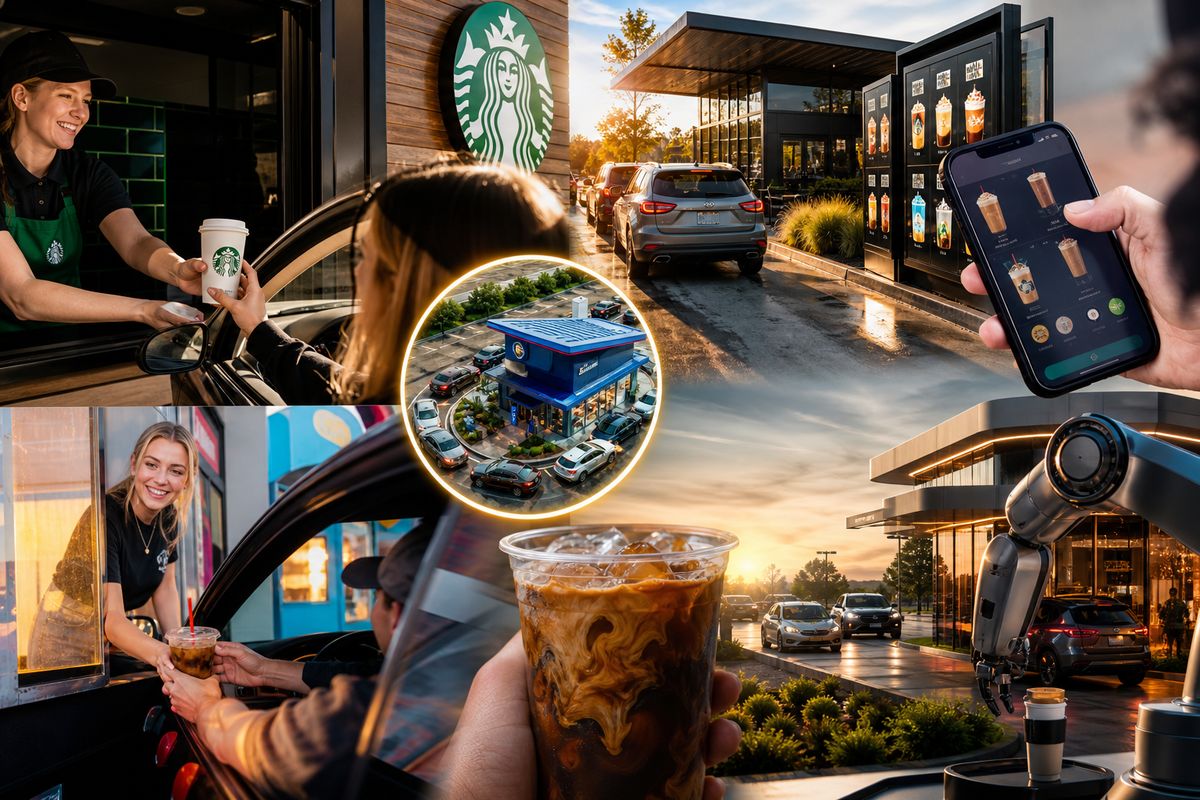
The Drive-Thru Coffee Landscape in 2026
Pull up to any suburban intersection in America this summer and you are almost certain to see a queue of cars snaking around a coffee shop. Drive-thru lanes have become the backbone of the quick-service coffee industry, and in 2026, the race to own that tarmac is fiercer than ever. Starbucks, the long-reigning king, now operates more than 5,600 drive-thru locations across the United States. But a new challenger, 7 Brew, is turning heads with a model built entirely around double-lane speed and limitless customisation. The question is no longer whether drive-thru matters; it is who does it best.
New data from Coffee Near You, published in July 2026, reveals that roughly 51 per cent of all U.S. Starbucks stores now have a drive-through lane, totalling 5,682 confirmed locations. That is a significant share, but it also means that nearly half of Starbucks outlets remain walk-in only, typically in dense urban cores, malls, and licensed stores inside Target or airports. Meanwhile, 7 Brew, which launched its first stand in Arkansas in 2017, has expanded to hundreds of double-drive-thru stands across the Sun Belt and beyond. Both chains are chasing the same prize: the morning commuter with a smartphone and a craving for caffeine.
Starbucks Drive-Thru: The Numbers Behind the Leader
Starbucks has not released an official count of its drive-thru locations in 2026, but third-party indexing by the Coffee Near You team paints a detailed picture. Based on OpenStreetMap feature data, approximately 51 per cent of U.S. and Canadian Starbucks stores have a confirmed drive-through lane. That translates to 5,682 U.S. locations and roughly 500 more in Canada, for a North American total of about 6,182. The highest concentration of drive-thru Starbucks stores is in the Sun Belt and Mountain-West states, where land is cheaper and car-first commuting is the norm. Texas, California, and Florida lead by raw count: California has 1,128 drive-thru Starbucks (53 per cent of its 2,120 stores), Texas has 495 (56 per cent), and Florida has 332 (55 per cent).
But the real story is in the share of stores with a lane. Indiana tops the list at 71 per cent of its Starbucks locations equipped for drive-thru, followed by Georgia at 69 per cent and Arizona at 66 per cent. These states are dominated by suburban and highway-adjacent real estate, where a drive-thru lane is almost a prerequisite for success. At the city level, Houston takes the crown with 64 drive-thru Starbucks, far ahead of second-place Phoenix with 42. San Antonio, San Diego, and Portland round out the top five. The data also reveals a crucial operational detail: drive-thru lanes typically open 30 to 60 minutes before the café, often as early as 4:30 AM at commuter sites. That early start captures the pre-work rush that walk-in stores cannot touch.
Mobile Order and the Speed Advantage
Starbucks has baked digital efficiency into its drive-thru experience. Customers can place a Mobile Order & Pay order and bypass the speaker board entirely, heading straight to the payment or pickup window. The company claims this saves three to six minutes during the morning rush. For a commuter, that is the difference between being on time and being late. Newer Starbucks stores are also consolidating the traditional three-stage flow (speaker, payment, pickup) into a single window for payment and pickup, further shaving seconds off the transaction. Yet for all its scale, Starbucks still faces a structural limitation: roughly half its network has no drive-thru at all. That is where pure-play drive-thru rivals like 7 Brew see an opening.
How 7 Brew Is Redefining the Drive-Thru Experience
7 Brew has built its entire identity around the drive-thru lane. There are no walk-in cafes, no indoor seating, no food court kiosks. Every store is a stand with two drive-thru lanes, designed to process orders faster than a traditional single-lane setup. The company's website, updated for July 2026, touts "double drive-thru lanes built to help our efficient Brew Crew handcraft your drink fast without compromising quality." The emphasis on speed is central to the brand: 7 Brew claims its crew can deliver an order in under a minute during peak hours. That is a bold promise, especially when compared to Starbucks' typical three-to-five-minute window for a drive-thru order (before any Mobile Order bypass).
But 7 Brew is not just about speed. The company leans heavily into customisation, offering over 20,000 flavour and option combinations. Its menu includes 7 Originals, 7 Classics, 7 Energy drinks, teas, chai, matcha, lemonades, smoothies, shakes, and even handcrafted sodas (the 7 Fizz). The brand's marketing for July 2026 features a "Chiller Nights" promotion from July 20 to 24, with frozen drinks available after 7 PM, and a new "Sippin' Sunshine" merchandise drop. The tactic is to position 7 Brew as a lifestyle brand, not just a coffee pit stop. Its tagline on the homepage is "Cultivate Kindness," and the company emphasises friendly service as a key differentiator.
Number of locations? The 7 Brew website does not publish an exact count, but the chain has expanded aggressively since its founding in 2017. As of mid-2026, it operates in at least 15 states, mostly across the South and Midwest, with plans to enter new markets. Its stores are concentrated in suburban areas with high car traffic, the same terrain where Starbucks drive-thru coverage is highest. The two chains are now direct competitors for the same real estate, often appearing within a mile of each other. And unlike Starbucks, 7 Brew puts every one of its stores in the drive-thru game. For customers who want speed and no-hassle ordering, that is a compelling proposition.
Why Drive-Thru Dominance Matters for the Coffee Industry
The drive-thru lane is no longer a convenience; it is a strategic asset. Coffee chains that invest in drive-thru infrastructure capture the highest-margin customers: morning commuters who make frequent, low-friction purchases. According to industry analysis, drive-thru transactions account for roughly 60 per cent of all quick-service coffee sales in the United States, and that share has been growing steadily since the pandemic reshaped commuting habits. Starbucks knows this. Its push to add drive-thru lanes to existing stores and to design new stores with dual lanes is a response to the market reality that walk-in traffic is declining in many suburbs.
But scale alone does not guarantee loyalty. The data from Coffee Near You shows that Dunkin' actually has the highest drive-thru share among the seven chains indexed, though specific numbers were not provided in the source material. That suggests Dunkin' has made drive-thru a near-universal feature, while Starbucks still treats it as an option. 7 Brew, by making drive-thru the only option, creates a clear brand promise: we are built for your car. In an era when customers value speed and convenience above almost everything else, that clarity matters. It also allows 7 Brew to optimise its real estate choices, avoiding expensive urban leases and focusing on lower-cost suburban parcels where a double-lane stand can generate high volumes.
There is also a technology angle worth noting. Both chains are investing in digital ordering and AI-powered voice recognition at the speaker board. Starbucks has been testing voice-activated ordering in select drive-thrus since 2023, and 7 Brew is reportedly trialling similar systems. The goal is to reduce labour costs and further speed up the order-taking process. In a tight labour market, automation is not a luxury; it is a necessity. The chain that can deliver a seamless, low-touch drive-thru experience while maintaining drink quality will win the next wave of market share.
What's Next for Drive-Thru Coffee?
Looking ahead, the battle for the drive-thru lane is likely to intensify on several fronts. First, expect Starbucks to accelerate its conversion of walk-in stores to drive-thru locations where zoning and lease terms allow. The company has already stated in past investor calls that drive-thru stores generate higher returns and better customer satisfaction scores. But converting a downtown store is difficult; many leases prohibit exterior modifications. That means Starbucks' future drive-thru growth will come from new builds in suburban and exurban areas, exactly where 7 Brew is also expanding. The collision course is set.
Second, the definition of "drive-thru" itself may evolve. Both Starbucks and 7 Brew are experimenting with curbside pickup and walk-up windows as alternatives to full lanes. But the real innovation could come from autonomous delivery vehicles that double as mobile pickup points. Imagine a self-driving van stocked with pre-ordered drinks serving a parking lot near a business park. That is not science fiction; companies like Nuro have already tested such concepts with other retailers. Coffee is an ideal product for this model because it is high-frequency and low-unit-cost. The first chain to integrate autonomous delivery into its drive-thru ecosystem could leapfrog the competition.
Finally, the customer experience will become more personalised. With mobile ordering data, chains can predict what a regular wants before they even pull up to the speaker. Starbucks already does this to some extent with its loyalty programme, but 7 Brew, with its emphasis on customisation, could take it further. Imagine a system that remembers not just your usual order but your preferred sweetness level, milk type, and even the time of day you typically visit. That level of personalisation, combined with speed, is the holy grail of drive-thru coffee. It is not a matter of if, but when.
Closing Thoughts
The drive-thru coffee market in 2026 is a story of two strategies. Starbucks plays the scale game, leveraging its massive network of walk-in and drive-thru stores to capture customers at every touchpoint. 7 Brew plays the focus game, doubling down on a single, optimised format designed for maximum speed and customisation. Both approaches have merit, but the data suggests that customers are increasingly voting with their wheels. The rise of drive-thru-only chains and the conversion of traditional cafes into hybrid models is a structural shift, not a fad.
For the average coffee drinker, this competition is good news. It means faster service, more choices, and better prices. The real winners will be the chains that can balance speed with a human touch, automation with warmth. In a world where every second counts, a great drive-thru experience is worth its weight in gold. And as the summer of 2026 heats up, the race to serve you from your car window is only just beginning.