Timemore Autospin and the 2026 WDT Tools Market: Electric Distribution Meets Classic Technique
Timemore Autospin brings electric WDT to espresso puck prep
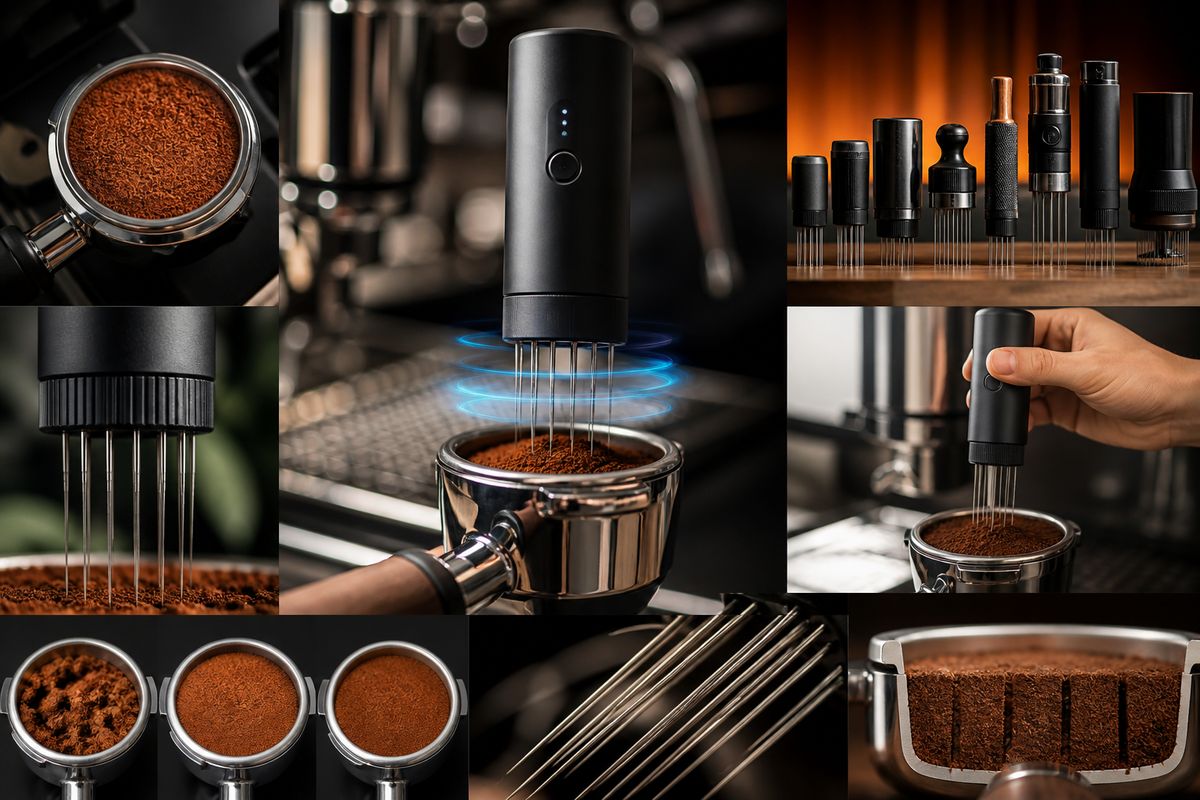
Espresso enthusiasts have a new tool to consider in 2026. The Timemore Autospin WDT tool, an electric distribution device, has arrived on the market with a simple promise: cleaner puck preparation, less channeling and more consistent results in the cup. Unlike traditional manual WDT tools that require the barista to stir the coffee bed by hand, the Autospin uses rotating needles that activate at the press of a button. Timemore describes it as a compact tool for people who want to work faster and more consistently without giving up control.
The Autospin is positioned as a thoughtful addition to espresso machine accessories for both home baristas and those with more advanced workflows. It is designed specifically for straight 58mm filter baskets, which covers a large share of prosumer machines from brands such as ECM, Rocket, Profitec, Lelit and La Marzocco. However, Timemore is clear about the limitations: the Autospin is not suitable for curved baskets or three-lug portafilters. That restriction matters, because many entry-level machines use smaller or tapered baskets, and a tool that cannot sit flush against the basket walls will do more harm than good.
The unit charges via USB-C and Timemore recommends charging roughly every three months to maintain battery performance. Notably, the charging cable is not included in the box, a small but irritating omission for a product that relies on periodic charging. Cleaning is handled with a brush or air blower, and the company warns against pouring ground coffee into the top of the device, as that can damage the motor. For anyone who has watched a spinning WDT tool fling coffee across the counter, that warning is worth heeding.
WDT explained: why distribution tools matter more than grinders
For readers unfamiliar with the term, WDT stands for Weiss Distribution Technique. The method is deceptively simple: use ultra-thin needles to gently stir the coffee bed in the portafilter basket before tamping. The goal is to break apart the clumps that grinders inevitably produce, and to redistribute grounds into low-density areas so that water extracts evenly across the entire puck. Without proper distribution, water finds the path of least resistance and carves channels through the coffee, leading to sour or bitter shots that vary from one day to the next.
The importance of this step is often underestimated. As one 2026 buying guide from print2webcorp.com notes, after hundreds of test shots, uneven puck density, not grinder quality, is the hidden variable most home baristas ignore. Freshly ground coffee carries static, retains small clumps and can land unevenly in the basket, particularly with single-dose grinders, darker roasts and changes in humidity. A dosing funnel keeps grounds in the basket, but it does not fully distribute them. Tapping the portafilter can level the surface, but it can also shift coffee toward the edges or create hidden density differences.
This is where a WDT tool earns its place on the counter. Fine needles separate clumps and move grounds into low areas, creating a more consistent density before tamping. The technique is not about aggressive stirring until the coffee looks fluffy; it is about creating an even bed with as little disruption as possible. That distinction is critical, because a tool that drags large channels through the puck can make extraction worse than no distribution at all.
The 2026 WDT tool market: eight tools, one clear winner
The WDT tool category has expanded rapidly, and the August 2026 market is crowded with options ranging from budget gadgets to precision instruments. A four-week test by print2webcorp.com evaluated eight of the most recommended tools, tracking shot consistency, channeling frequency and workflow time. The most surprising finding was how little price predicted performance. A $10 tool with stiff needles kept pace with a $94 spirographic gadget on flat-burr grinders, while a mid-priced adjustable model won the overall recommendation.
The editor's choice was the KNODOS WDT Tool Model B, which earned a 4.8-star rating across 129 reviews. Its defining feature is a dual needle system: 0.4mm needles for breaking up stubborn clumps and a 0.25mm replacement set for ultra-fine finishing work on lighter roasts. It also offers a 120-degree angle adjustment, which proved useful for reaching the edges of shallow VST-style 58mm baskets where straight tools miss grounds hugging the wall. The anodized aluminium body and magnetic storage top add to its appeal, though it is a relatively new entrant compared with established brands.
The best value pick was the MHW-3BOMBER WDT Tool T6126, backed by 982 verified reviewers at 4.7 stars. It features 0.4mm stainless needles, an adjustable needle range and compatibility with 51mm, 54mm and 58mm baskets, which means one tool can serve multiple machines. The budget pick was the Nessus WDT Tool, priced under ten dollars with 20 needles and a built-in cleaning brush, solving the perennial problem of dried coffee stuck between the prongs. Other tested tools included the Subminimal Flick with retractable needles, the Normcore WDT V3 Walnut with a magnetic stand, the MHW-3BOMBER Cyclone YU 58mm, the ARO Orbit PRO with three-gear auto rotation and the MEION 7-Needle WDT Tool.
How the Timemore Autospin fits into the modern espresso workflow
The Timemore Autospin enters this market with a fundamentally different approach. Instead of relying on the barista's hand to move the needles, a motor spins them at high speed, distributing coffee across the basket in a matter of seconds. This has clear appeal for home baristas who want to shorten their morning routine without sacrificing quality, and for café environments where speed and repeatability are paramount. The tool is marketed as delivering faster, cleaner and more consistent espresso every day, which is exactly what a busy coffee station needs.
However, the Autospin is not a universal solution. Its compatibility is limited to straight 58mm filter baskets with conventional two-lug portafilters. That excludes a significant portion of the market, including many La Marzocco home machines and virtually all 54mm and 51mm systems. Timemore's own guidance acknowledges this, stating that the model is not the right choice for curved baskets or three-lug portafilters. Baristas who own multiple machines or who plan to upgrade will need to consider whether this limitation cramps their workflow.
Battery life and maintenance are also factors. The three-month charging cycle is reasonable for a device used daily, but the lack of an included charging cable is an unnecessary friction point. Cleaning requires care with a brush or air blower, and the warning about not pouring ground coffee into the top suggests that the motor is not as robust as the rest of the tool. Still, for the right user, the Autospin offers a level of consistency that manual WDT can struggle to match, because it removes the variable of human hand movement entirely. That consistency is precisely what the 2026 testers found valuable in the top-performing manual tools, and the Autospin automates it further.
Needle gauge, count and handle: what actually makes a WDT tool effective
Whether a barista chooses the electric Autospin or one of the eight manual tools tested this year, the underlying principles of effective distribution remain the same. Needle thickness matters more than appearance. Most experts, including the team at NepoCoffee, identify 0.25mm to 0.35mm as the sweet spot for home espresso preparation. These needles are thin enough to move through finely ground coffee without creating large tunnels or dragging big channels through the puck. Thicker needles tend to push grounds around rather than delicately separating them, which can worsen density variations.
Needle count and spacing should suit the basket size. For standard 58mm baskets, a tool with roughly six to nine fine needles is often comfortable. Too few needles make distribution slower and less consistent; too many can feel dense and difficult to move through the coffee, particularly in narrower 51mm or 54mm baskets. The ideal layout allows the user to reach the basket edges without scraping the wall or repeatedly pulling grounds out of place. The KNODOS Model B succeeded in testing partly because its angle adjustment addressed exactly this issue.
The handle and stand are not afterthoughts. A stable, balanced handle lets the user employ a light grip and small circular movements instead of digging into the coffee. Wood handles add warmth to an espresso bar, but the material must be properly finished for a kitchen environment. A dedicated stand protects the needle tips, keeps the tool upright and makes it easy to grab with one hand while holding the portafilter with the other. These details separate a useful tool from a novelty item, and they apply as much to the Autospin as to manual tools, even though the Autospin's motorised head changes the physical interaction.
What WDT can and cannot fix
It is important to set realistic expectations. WDT reduces channeling caused by poor distribution, but it cannot correct stale coffee, a severely misaligned burr set, an unsuitable basket or a grind that is far too coarse. As NepoCoffee's guide points out, if a shot is running in 18 seconds, no accessory will replace a proper grind adjustment. WDT is one useful control point in a careful espresso workflow, not a magic wand that transforms bad habits into good espresso.
This reality check is particularly relevant when considering the Timemore Autospin. The electric tool can distribute coffee faster and more consistently than most manual methods, but it will not compensate for beans that are past their peak or a grinder that produces excessive fines. It also introduces a new variable: battery level. A dead Autospin in the middle of a busy morning is a workflow interruption that no manual tool would cause. Baristas who value simplicity and reliability above all may find a well-designed manual WDT tool, such as the MHW-3BOMBER T6126 or the KNODOS Model B, to be a more durable daily companion.
That said, the rise of electric distribution tools signals a broader trend in the coffee industry. Manufacturers are increasingly focused on removing human error from puck preparation, just as they have done with grind-by-weight dosing and automated tamping. The Autospin is part of this movement, and its arrival alongside the spirographic ARO Orbit PRO suggests that motorised distribution is moving from novelty to mainstream. The question is not whether electric WDT works, but whether it works for a particular machine, workflow and budget.
The verdict: is the Autospin a game changer or a gimmick?
On the evidence available, the Timemore Autospin is neither a revolutionary game changer nor a useless gimmick. It is a purpose-built tool that excels in a specific scenario: home baristas and small cafés using straight 58mm baskets who want to speed up puck prep and achieve more repeatable extraction. For those users, the rotating needles offer genuine value, reducing the skill required to distribute coffee evenly and freeing up attention for other parts of the shot. The USB-C charging and three-month battery life are practical enough for daily use, provided the missing cable does not become a dealbreaker.
The broader WDT tools market in 2026 is healthy and competitive. The print2webcorp testing demonstrated that excellent distribution can be achieved at almost any price point, and the KNODOS Model B's editor's choice award shows that innovation in manual tools continues. The NepoCoffee perspective reinforces that the fundamentals, thin needles, appropriate count, stable handle and safe storage, matter more than flashy features. The Autospin adds an electric convenience layer on top of those fundamentals, but it does not change the underlying physics of coffee extraction.
For baristas who already own a proven manual WDT tool, the Autospin is an optional upgrade rather than a necessity. For those starting from scratch and weighing the options, the decision comes down to priorities. If speed and consistency are paramount, and the 58mm straight basket limitation is acceptable, the Timemore Autospin is a compelling choice. If flexibility and value are more important, the MHW-3BOMBER T6126 at best value, or the under-ten-dollar Nessus as a budget starter, remain smart buys. Either way, 2026 has made one thing clear: WDT is no longer an obscure technique for obsessive home baristas. It is a standard part of espresso preparation, and the tools have never been better.